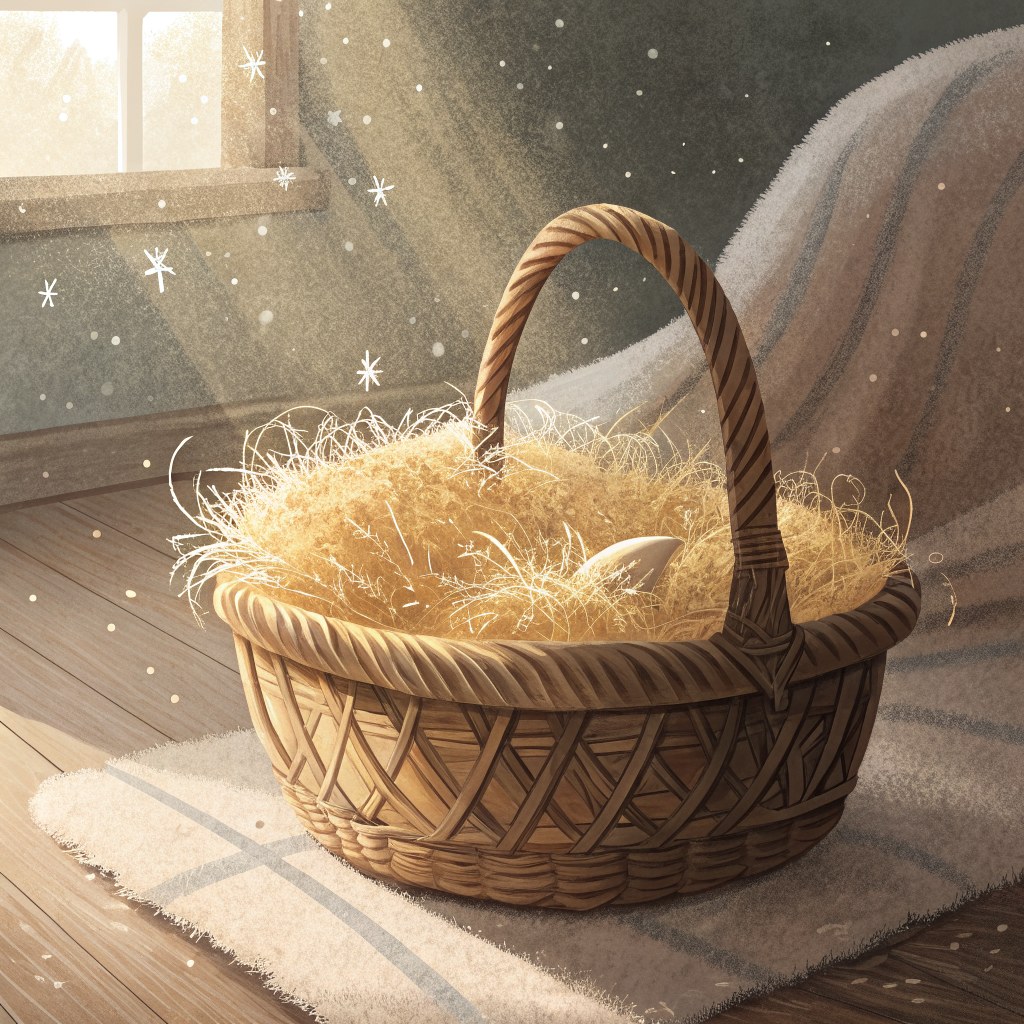
The evening was going gold at the edges when Grandma came down the path with a small wicker basket, lined with straw as soft as a nest. "The hens have been busy today," she said. "And tonight it's your turn to bring the eggs in."
Noa took the handle with both hands. The basket felt light and important, the way a birthday parcel does before you open it.
At the coop gate, Grandma crouched down. "There's only one rule," she said, "and it goes like this: soft hands, slow hands, one egg at a time."
"Soft hands, slow hands, one egg at a time," said Noa, and pushed the little door open.
Inside, the henhouse was warm and dim and smelled of straw and dust. The hens shuffled on their roosts, murmuring their sleepy evening chatter. And there, in the first nest box, sat an egg the colour of milky tea.
Noa reached fast — because it was exciting, because it was the very first one — and snatched it up and swung it down into the basket.
Tock. Then a tiny, papery crick.
The egg had knocked the basket rim. A thin line ran across its shell like a crack in ice on a puddle. Noa stood very still and did not want to look at it. Somewhere behind, a hen clucked twice.
Grandma's face appeared at the little door. She looked at the egg. She did not tell Noa off.
"That one can go in tonight's pancakes," she said. "Shells are thin as paper, you know. What was the rule?"
"Soft hands, slow hands, one egg at a time," said Noa, in a rather small voice.
So Noa tried again, and this time slowly. Two hands, cupped like a little bowl. Lift. Carry it the way you carry a full cup of water across a room — not stopping, not rushing, just careful. Then down into the straw, and let go last of all.
It worked. The egg sat in the straw, round and whole and warm as a pocket.
"Soft hands, slow hands, one egg at a time," Noa whispered, and did the next nest the same way. And the next.
The last nest belonged to the speckled hen, who was nervous about everything: watering cans, wellies, weather. She puffed up her feathers and grumbled low in her throat.
Noa knelt down in the straw and stayed put, breathing quietly, saying the rule under her breath like a little song. The speckled hen's feathers flattened. She stepped sideways. Noa slid one hand underneath, ever so gently, and cupped the other hand over the top, and out came the last egg — brown, freckled, still warm from her.
"Thank you," said Noa. The hen made a soft, settling sound, which is very nearly the same thing.
Every egg after the first one came home whole, and the cracked one came home too, for the pancakes. The basket sat by the warm stove, and Noa curled up beside it under a blanket, watching the shells glow in the firelight while the coop outside went quiet, one hen at a time.
Soft hands. Slow hands. And then, at last, sleep.