After the rain, the garden path was scattered with worms and slow-moving things, and Noa walked it carefully, watching where her boots came down. Grandpa always said the path belonged to more creatures than just people, and this morning it certainly did.
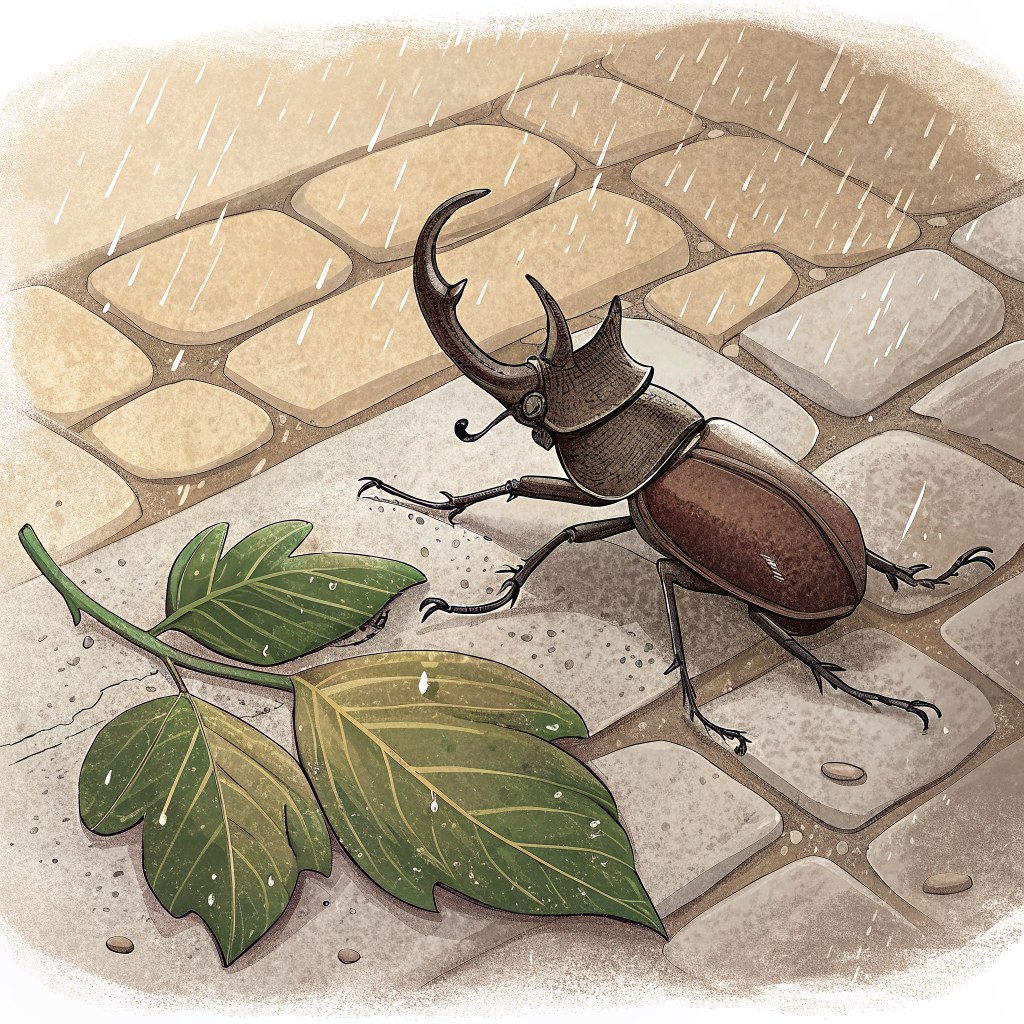
Halfway to the shed, Noa stopped. There, right in the middle of the paving stone, was a stag beetle. It was bigger than her thumb, dark and shining like a wet chestnut, with two little curved horns at the front. It lay on its back, legs waving at the sky, unable to turn over.
Noa crouched down close. The beetle's legs paddled the air and got nowhere. A blackbird hopped along the fence, tilting its head, and Noa felt a small worry tighten in her chest. If she walked on, the bird might come. If she rushed, she might hurt those thin waving legs.
"It's all right," Noa said quietly, mostly to steady herself. She looked around for something better than fingers. A wide green leaf had blown down by the wall, still holding a bead of rainwater. Noa picked it up and laid it flat on the stone, right beside the beetle.
Then she waited. She did not grab. She slid the very edge of the leaf under the beetle's back, slow as the minute hand on the kitchen clock, and tilted it the smallest bit. The beetle's legs caught the leaf. It gripped, rocked, and all at once flipped itself the right way up.
Noa let out a breath she hadn't known she was holding.
The beetle sat still on the leaf, getting used to being upright again. Its horns gleamed. Up close Noa could see the ridges on its back like the grain in Grandpa's workbench, and the way its feet ended in tiny hooks. It was, she thought, one of the most careful and complicated things she had ever seen, and it had nearly been squashed under a boot without anyone noticing.
The blackbird was still watching. So Noa carried the leaf, level as a full cup, over to the log pile by the fence where the shade was cool and damp. Beetles like that lived in old wood; Grandpa had told her so. She lowered the leaf against a soft, crumbly log and tipped it gently.
The stag beetle stepped off. It climbed into a shadowed gap between the logs, slow and sure, and disappeared where no bird could follow.
"There," Noa whispered. She stayed a moment longer, looking at the log pile — the mossy tops, the little doorways of dark between the wood, a whole quiet town of creatures she usually walked straight past.
Grandpa came out with two mugs of cocoa and found her still crouched there. "Lost something?" he asked.
"Found something," said Noa. "A stag beetle. It was stuck on its back. I turned it over."
Grandpa nodded slowly, the way he did when something mattered. "Those are getting rare," he said. "You did it a good turn." He handed over a mug and they sat together on the damp step, not minding the wet.
For the rest of the morning Noa kept noticing things she would have missed before — a snail's silver trail along the wall, a ladybird folded shut against the cold, the worms easing themselves back into the soft ground. She stepped around every one of them.
That night, warm under the blanket, Noa thought about the log pile in the dark. Somewhere in its damp little rooms the stag beetle would be tucked away, safe, its horns resting, its legs still at last. The blackbird was asleep on its branch. The worms had gone home under the earth.
Noa's eyes grew heavy. The rain had stopped. The garden was quiet and full, every small creature settled in its own soft place, and she let herself sink down into sleep as gently as a leaf coming to rest on the ground.