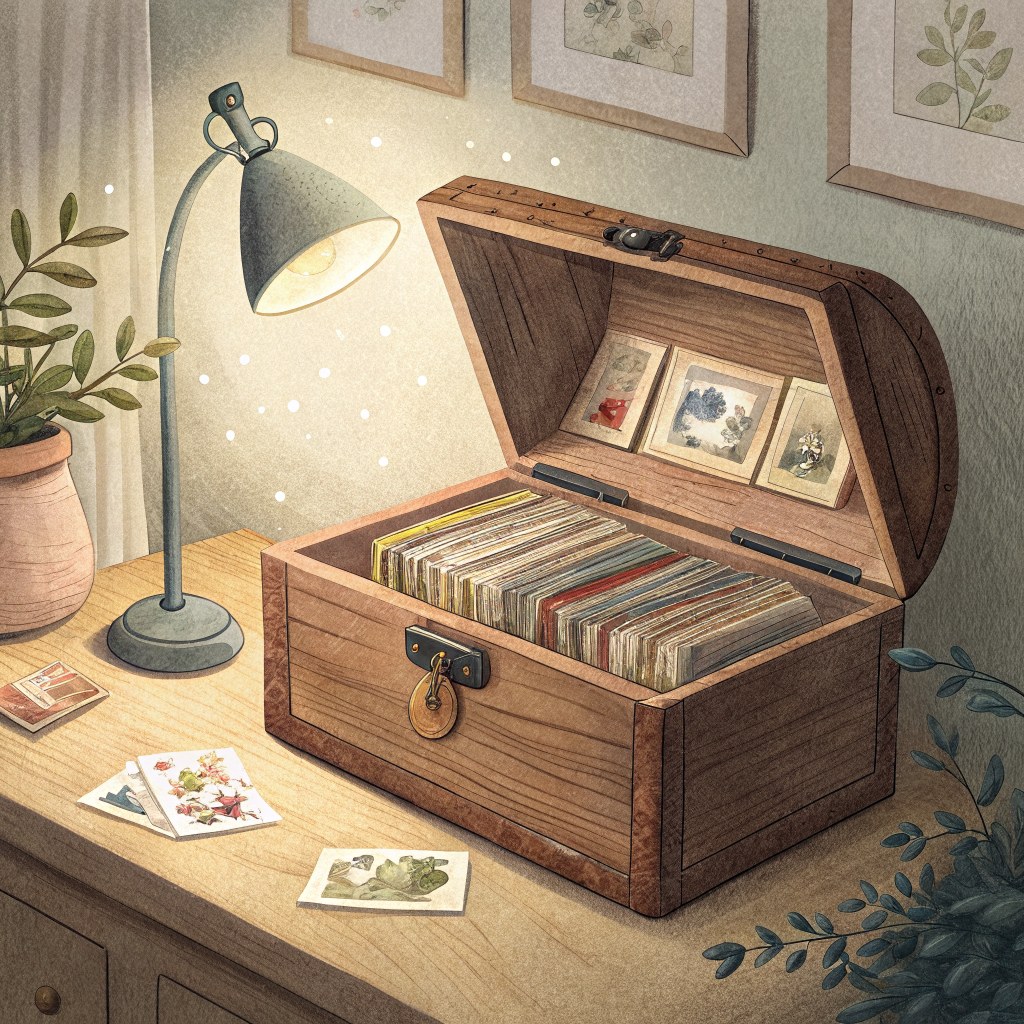
On the shelf above Mom's desk there was a wooden box with a brass clasp, and inside it lived the postcards — years and years of them, standing in a neat row like books in a tiny library, oldest at the front, newest at the back. Sam was not exactly forbidden to touch the box. But he had never asked, either.
He was hunting for a stamp that Saturday — a proper faraway one, for the album he kept under his bed — and he remembered the postcards all at once. Some of them, he was sure, had come a very long way. He lifted the box down one-handed, in a hurry. That was the mistake. The clasp caught his sleeve, the lid swung open, and the whole tidy row of years slid out and fanned across the floor like an enormous hand of cards.
For a moment Sam did not move at all. The postcards lay everywhere — under the desk, beneath the chair, one balanced on his slipper. A lighthouse. A camel. A bridge in the rain. None of them looked damaged. That was the trouble with it, really: he could scoop them up, square the corners, snap the clasp shut, and the box would look exactly as it always had. Nobody would know the years inside were all in a muddle. Nobody except him.
He almost did it, too. He gathered up a handful and set it in the box, and the box looked fine, and something in him did not. His hands went slow and heavy, the way they did when a thing wasn't right. So he put the handful down, walked to the kitchen, and stood in the doorway until Mom looked up from her tea.
"I took the postcard box down without asking," he said, all in one breath, "and I spilled it, and the years are mixed up. I'm sorry. I'd like to put them back the way they were."
Mom was quiet for a moment. Then she said, "Thank you for telling me straight away. The order matters — I keep them by their dates. Do you think you can find the dates?"
"Postmarks," said Sam. "I'll look at the postmarks."
So began the sorting. He cleared a stretch of floor and laid the postcards out in long lines, one line for each year. The postmarks were little circles of ink with the date hiding inside — some crisp as a new coin, some faint as breath on a window — and he read each one and slotted card after card into its place.
It should have been dull, and it wasn't, because of the questions. "I wonder who chose the camel," he said, turning a card with a stamp from very far away. "I wonder if it rained the whole holiday," he said over the bridge in the rain. One card was signed only your friend from the harbour, in handwriting that rolled like waves, and Sam wondered about that one longest of all.
The very last card was the lighthouse — and its postmark was a smudge. No circle, no date, nothing. Sam turned it over twice. Where did a card with no date belong? Then he read the message itself, and there it was, in the very first line: They have painted the lighthouse red and white this summer — at last! He looked down the long lines of sorted years and found the harbour card, written in that same rolling-wave hand, from one summer in particular. The lighthouse card slid in beside it, and the smudged card had a home.
When Mom came in, the box stood on the desk with the clasp done up and every year in its place. She went through it slowly, front to back, and nodded. "All the years back where they belong," she said. Then she slid one card out — the harbour one — and smiled. "Go on, then. Ask me."
"Who is the friend from the harbour?" asked Sam.
The answer lasted all the way to bedtime: an old friend of Mom's who had lived where the boats came in, who wrote whenever the tide brought news, and who had watched them paint the lighthouse red and white one summer, stripe by stripe. Sam listened with heavy eyes, and the story got slower and softer the way stories do at the very edge of sleep.
Downstairs, the box sat closed on its shelf, every year in its right place. And in bed, Sam drifted along the rows of postcards — the camel, the bridge, the red-and-white lighthouse — like a little boat going harbour to harbour, and somewhere past the last postmark, he fell asleep.