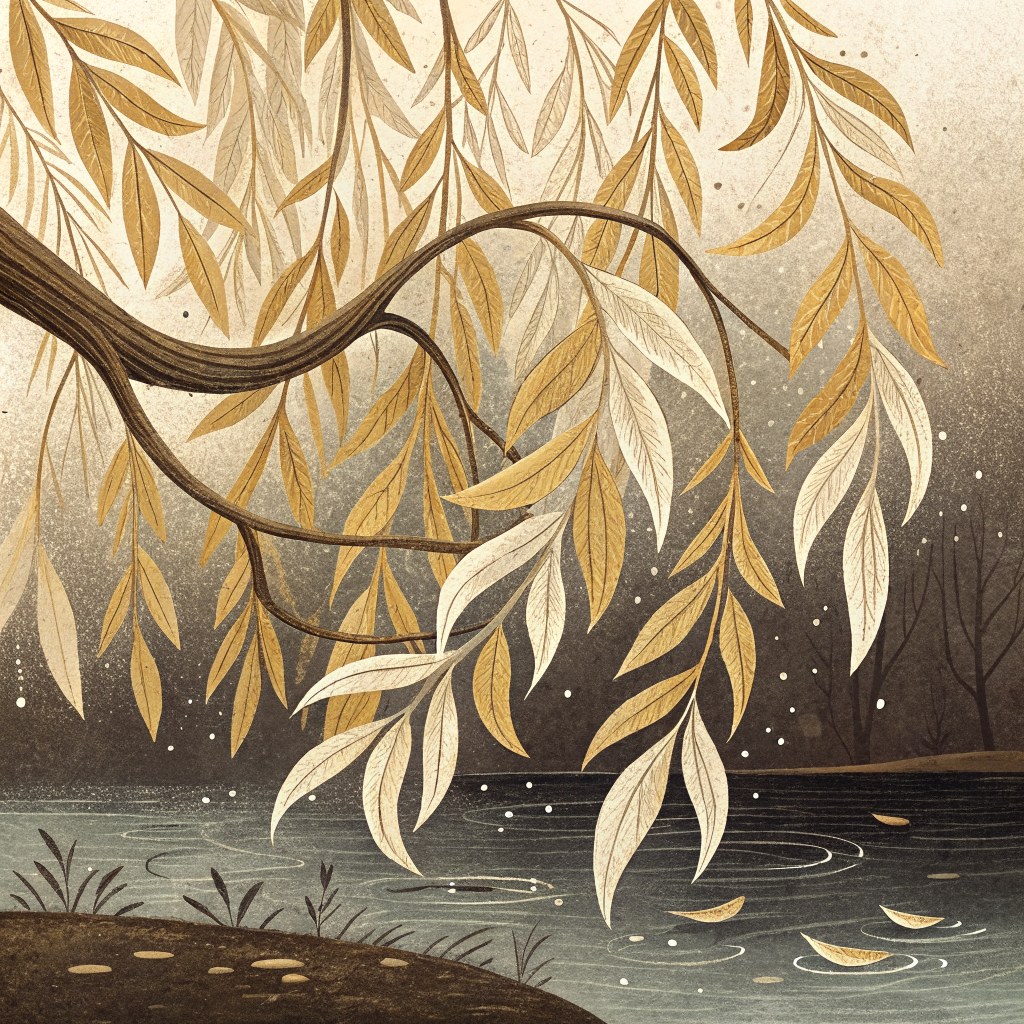
The willow by the pond had been the greenest thing in the whole garden all summer. Leo used to sit under it when the afternoons went hot and sleepy, watching its long ribbon leaves brush the water like fingers checking to see if the pond was still there.
But this morning, when Leo came down to the pond with a slice of toast, the willow was doing something new. Its leaves had gone thin and pale, the color of weak tea. A few had let go and were floating on the water, slow and yellow, turning in tiny circles. Leo stood very still and did not eat the toast at all.
Grandpa came down the path with his coffee. "Autumn found the willow," he said quietly. "It happens every year."
"It looks sad," Leo said, in a small voice. "Like it's giving everything up." His hands were closed tight around the cold toast. All summer the willow had been the best part of the garden, and now it was coming apart leaf by leaf, and there was nothing to do about it. That was the part that made his legs want to sit down. You could fix a broken thing. You could not tell a tree to keep its green.
So Leo did the only thing he could think of: he sat down under the willow anyway, the way he always had, and kept it company.
And because he sat, he began to notice.
The pale leaves, up close, were not really pale — they were gold, hundreds of small golds, some the color of honey and some nearly white where the light came through them. When one let go it did not fall straight down. It swung, side to side, taking the long slow way to the water, as if it were in no hurry at all.
A leaf landed on the pond and became a little boat. Leo watched it drift, and a water-strider hopped aboard and rode it a while. Under the surface, orange fish came up to nibble at the floating leaves and then thought better of it and sank away again. The willow was not giving everything up, Leo thought. It was handing things out.
"Look, Grandpa," he whispered. On the bare tips of the branches, where leaves had fallen away, he could see tiny hard buds already tucked close to the wood — small and brown and patient. "It's still got next spring inside it. It's just holding it where the cold can't get it."
Grandpa crouched and looked. "So it does," he said. "Been doing that quietly the whole time you were watching the leaves go."
Leo gathered a handful of the yellow leaves from the grass, the crispest and most perfect ones, and laid them out on the flat stone by the pond — a row from palest to deepest gold, a little collection to keep. The willow, he decided, should not lose its whole year with no one to say it was beautiful. So he sat and said it, out loud, the way you'd sit with a friend who was feeling low and stay until they felt less alone.
By the time the toast was long forgotten and cold, the sun had swung around behind the branches. The bare places did not look sad anymore. They looked like a tree resting, the way Leo rested under a blanket when the day had been too long.
That evening, at the window, Leo could just see the willow going dark against the last light, its thin branches swaying, letting a few more leaves take the long swinging way down to the water. His row of gold leaves sat safe on the sill.
Leo pulled the blanket up. Somewhere out there the little brown buds were holding spring close and patient, and the pond was carrying its small gold boats, and the willow was not lonely, because someone had stayed. His eyes went soft and slow. Outside, one more leaf let go, swinging, unhurried, and the dark folded gently over the garden, and over him, too.