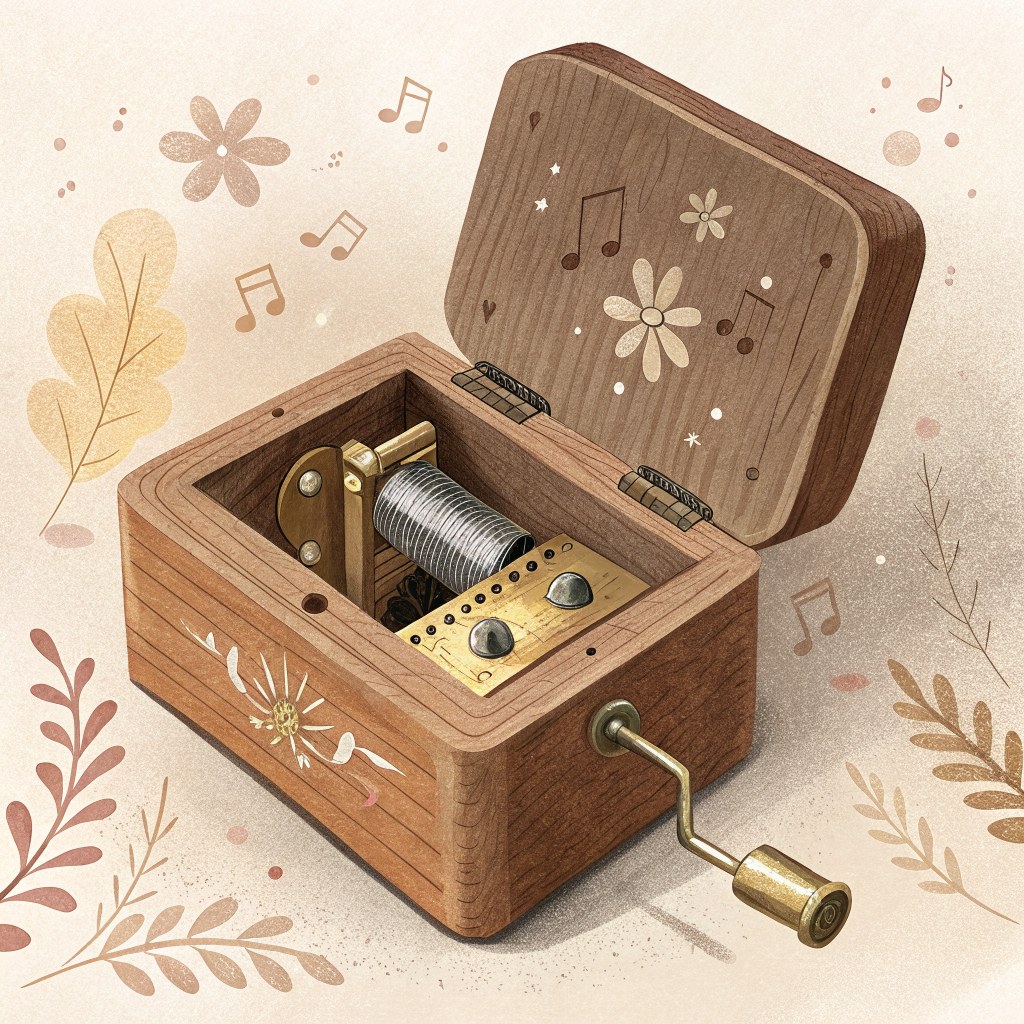
"I wonder," said Mia, kneeling by the little wooden music box, "who taught you your song?"
The box had lived on Grandma's shelf longer than Mia had been alive. Wind its brass key and a tune would climb out, thin and silvery, like light coming through a keyhole. But tonight, when Mia turned the key, the box only clicked. No song. Just a dry little cough of nothing.
Grandma turned it over in her hands. "Something inside has come loose," she said. "A tiny piece, no bigger than a fingernail. Without it, the song can't find its way out. It must have fallen somewhere."
Mia went very still. Fix a whole music box? That felt far too big — like being handed a puzzle with the picture missing. But the silence where the song used to be tugged at her, and she could not leave it alone.
"I wonder where a tiny thing goes," she said, "when it decides to run away."
"Small things fall to the smallest places," said Grandma. "Start low. Start close."
So Mia started low. She lay flat on the rug where the box was wound each evening, cheek against the wool, and looked sideways along the floor the way you'd look across a field. One step. Just look at the floor — that she could do. Under the shelf, dust curled like little clouds. A button. A dried pea. But no gleam of brass.
"I wonder if it rolled," she murmured. Round things roll. Her eyes followed the slope of the old floorboards down toward the wall, and she crawled after them, slow and patient. Her hand met a cold ridge — the grate over the heating vent. Between the slats, something glinted.
She fetched a spoon and slid it under the grate's edge. Her hands were careful now, careful as lifting a sleeping cat. The grate lifted. Down in the dust below sat a coin, a paperclip — and a curl of metal smaller than a fingernail, catching the lamplight.
"There you are," Mia breathed, and her held breath came out in a rush.
But getting it was another big thing. The gap was narrow, and if she fumbled, the piece would fall deeper than any spoon could reach. Mia sat back and thought. One small step at a time, she told herself. Not the whole box. Just the reaching.
She wet the tip of her finger and pressed it gently to the little curl. It stuck, the way a crumb sticks to a fingertip. Slowly, slowly, she drew her hand up through the gap, breathing shallow, not daring to hurry. The piece rode up on her fingertip into the light.
"Now the hard part," said Grandma, but she was smiling, and she did not reach for the box. "You found it. You'll know where it belongs."
Mia peered inside the music box, at the little comb of teeth and the spinning barrel with its pins. There was a bent prong with a gap beside it — a gap exactly the size of the curl on her finger. Her hands wobbled. What if she pushed it wrong? But wobbly hands could still go slow. She settled the piece into the gap and pressed until it clicked home, a click that felt like a door shutting softly.
"I wonder," she whispered, "if you'll sing now." Then she took the brass key between two fingers and wound it, one careful turn, two, three, until the spring held tight. She let go. For a moment there was only the little whir of the barrel — and then the tune came climbing out, thin and silvery, exactly as it always had, as if it had only been waiting behind a shut door all along.
Grandma closed her eyes to listen. Mia closed her too. The song went round once, then round again, softer, the way songs do near the end of their winding.
Grandma carried the box to the shelf where it belonged, and Mia climbed under the blanket in the spare bed by her window. The last few silvery notes drifted down slower and slower, thinning into quiet. "I wonder," she thought, warm and heavy-eyed, "who taught you your song." And somewhere in the wondering, before the very last note faded, she was already asleep.