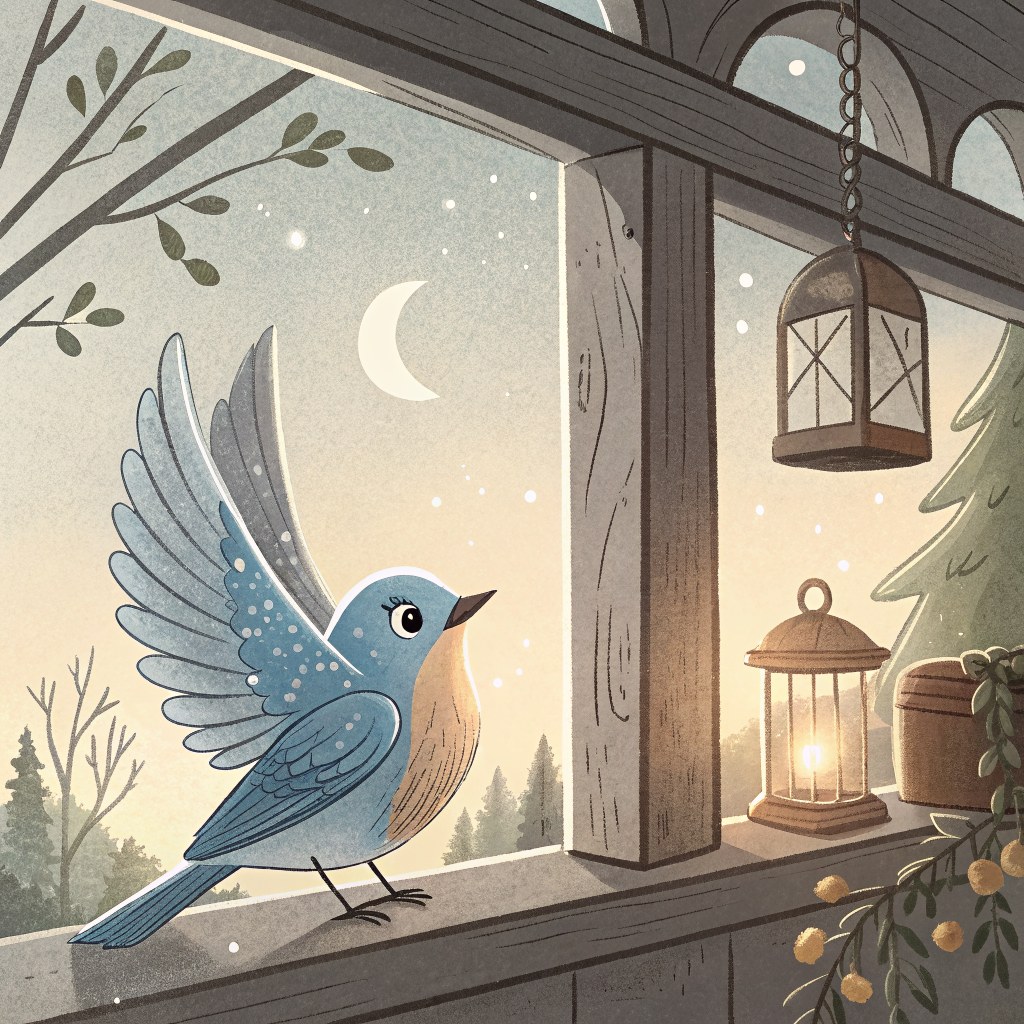
The garden at Grandma's house smelled like warm tomatoes and cut grass, and every evening after supper, Mia was allowed to explore it until the fireflies came out.
On the porch shelf sat Grandma's favorite thing in the whole house: a small blue bird made of glass, its wings caught mid-flap, its glass eye catching the last bit of sun. She had told Mia it once belonged to her own grandmother, all the way from a country across the ocean. "It's flown through a hundred years," she liked to say, "and it isn't done flying yet."
Mia loved to watch it, but was never, ever supposed to touch it.
One evening, while chasing a moth in lazy circles, Mia's elbow bumped the shelf. The blue bird tipped, wobbled — and tumbled to the porch floor with a small, terrible *clink*.
Mia knelt down fast. One wing had chipped, a tiny curl of glass sitting beside it like a fallen leaf. Her stomach dropped straight through the floorboards.
For a moment, Mia thought about scooping up the wing-piece, tucking the bird back exactly where it had been, angled just so, and saying nothing at all. Maybe Grandma wouldn't notice for days. Maybe she'd think it had always been that way.
But even holding that thought felt heavy, like carrying a stone in her pocket. Mia pictured Grandma's face if she found out later, after the fib had already been told — and that felt worse, somehow, than the chip itself.
So Mia picked up the bird and the little glass wing-curl, walked through the screen door — *creak, clack* — and found Grandma shelling peas at the kitchen table.
"Grandma," Mia said, voice smaller than usual, "I bumped the shelf. The blue bird fell. I broke its wing."
The words came out fast, all in one breath, like she needed to say them before she could change her mind.
Grandma set down her pea pod. For a second she just looked at the little bird cradled in Mia's hands, its chipped wing catching the kitchen light.
"Oh," she said softly. Then she reached out — not for the bird first, but for Mia, pulling her into a hug that smelled like peas and lavender soap. "Thank you for telling me."
"You're not mad?" Mia asked into her shoulder.
"I'm sad about the wing," she admitted. "But I'd be a lot sadder if you'd hidden it from me. That bird's just glass. You telling me the truth — that's worth more than any wing."
She found a tube of special glue in the kitchen drawer, the kind used for teacups and picture frames, and together they sat at the table while she fit the tiny curl back into place, Mia holding the bird steady with two careful fingers.
"There," Grandma said, turning it in the lamplight. A thin silver line ran along the wing now, like a small river on a map. "Now it has a story on it, too."
"Does it still fly?" Mia asked.
"Better than ever," she said, and set it gently back on the shelf, angled just so it caught the porch light through the window.
Later, tucked into the guest bed with the quilt pulled to her chin, Mia could hear crickets singing outside and the soft clink of Grandma washing the last dishes. The window showed one bright star, and somewhere past the porch, the little blue bird sat quiet on its shelf, wing mended, waiting for morning.
Mia let out a long, slow breath, the stone-heavy feeling from before completely gone, replaced by something light and warm, like a held hand. Eyes grew heavy. The crickets kept singing. And soon, Mia was fast asleep.