The evening was soft and gold when Leo bounced a rubber ball against the fence, again and again. Thump. Thump. Thump. It was a good sound, steady as a heartbeat, and Leo liked counting the bounces to see how high they could go.
Thirty-one. Thirty-two. Thirty-three.
On the thirty-fourth bounce, the ball skipped sideways off a knot in the wood, sailed clean over the fence, and disappeared into the neighbor's garden with a small, terrible tinkle.
Leo froze. That tinkle was not a good sound at all.
Peeking through a gap in the fence boards, Leo saw it — the neighbor's silver wind chime, the one that always sang softly when the breeze moved through the garden, now lying in pieces on the flagstones. One long tube had cracked clean in half. The little sun-shaped piece at the bottom had rolled under a rose bush.
Leo's stomach dropped like a stone in a pond. Nobody had seen. It would be so easy to just go inside, wash up for dinner, and never say a word. The ball could stay lost in the garden forever, as far as anyone needed to know.
But every time Leo pictured the neighbor stepping outside tomorrow morning, humming, expecting that gentle chime song and finding silence instead — the stone in Leo's stomach only got heavier.
"Okay," Leo whispered to nobody in particular, wiping sweaty palms on his shorts. "Okay."
He walked around to the front gate instead of climbing over the fence, because climbing over without asking felt like one more thing to explain, and knocked on the neighbor's door before his courage could leak out through his shoes.
The neighbor opened the door, wiping flour from her hands onto an apron. "Well, hello there," she said. "What brings you by?"
Leo's voice came out smaller than he meant it to. "I broke your wind chime. I was bouncing my ball and it went over the fence and it hit the chime and it broke and I'm really sorry."
The words tumbled out fast, like they'd been waiting behind a closed door too.
The neighbor's eyebrows went up, and for one long second Leo braced for something — a frown, a sigh, something heavy. Instead she just said, "Well. Thank you for telling me. Let's go take a look."
Together they walked around to the garden. The broken chime looked smaller and sadder up close, its silver tubes scattered among the rose bushes like fallen icicles.
"I can fix it," Leo said quickly. "Or — I don't know how to fix metal. But I could use my allowance. Or I could help in your garden until it's paid for. Whatever's fair."
The neighbor knelt down and picked up the cracked tube, turning it over in her hands. "You know," she said, "I've had this chime a long time, and honestly, it never sounded quite right. Too many low notes, not enough high ones. What if instead of fixing the old one, you helped me make a new one? I've got a coffee tin full of old spoons and bottle caps that would ring rather nicely, I think."
Leo blinked. "Really?"
"Really. Fetch that tin from the shed, would you?"
For the next hour, as the sky turned the color of ripe peaches, Leo and the neighbor sat on the back step sorting spoons by size, tying strings, testing which pieces made the brightest sound when they clinked together. Leo's fingers got sticky with garden dirt and his knees ached from crouching, but the stone in his stomach had melted away completely, replaced by something warm and light instead.
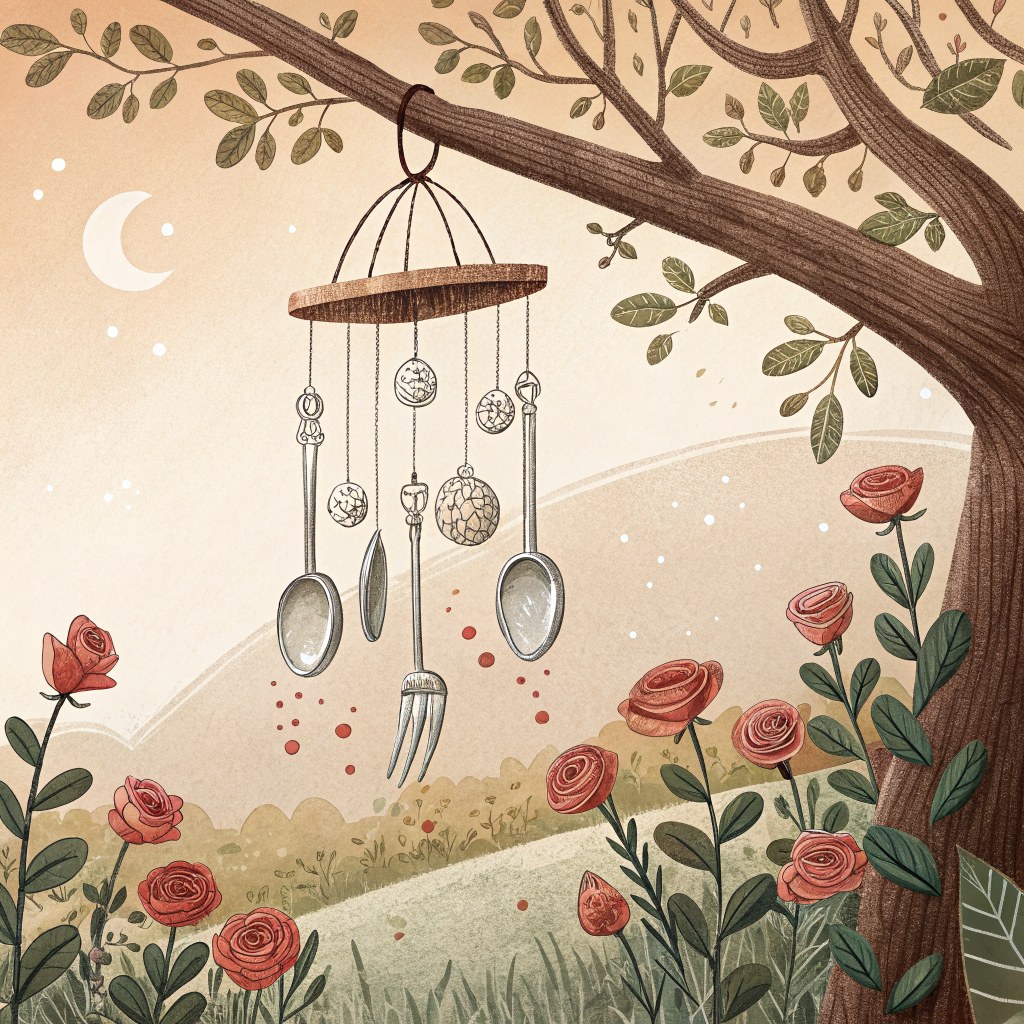
When the new chime finally hung from its branch — a crooked, clattery, wonderful thing made of mismatched spoons — a small breeze wandered through the garden and set it singing. It sounded nothing like the old one. It sounded better.
Walking home in the last of the light, ball tucked safely under his arm, Leo could still hear it faintly, ting-a-ling-ting, drifting over the fence like a lullaby someone had left out just for him.
By the time his head found the pillow that night, the whole day felt like it had been carried off on that same soft breeze — leaving only the quiet, tired kind of happy behind, and the faraway sound of spoons still singing in the dark.